
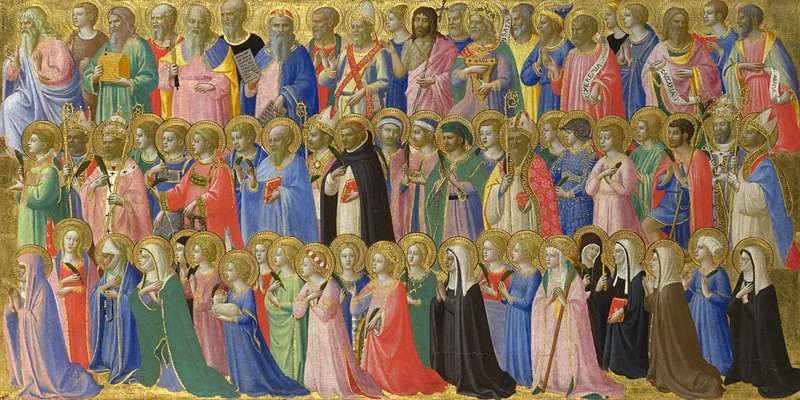
Fra Angelico. (1423). The Forerunners of Christ with Saints and Martyrs. [Egg tempera on wood (probably poplar)]. The National Gallery, London.
Dear All,
Please join us for services this week, which are taking place in person or via livestream through our YouTube Channel. You can find gathering times and service sheet links below.
Friday 30 November
10:30pm — BCP Holy Communion (Revd Dr Mark Scarlata)
Sunday 1 November
11.00pm — Holy Communion
Sermon: ‘All Saints’ (Revd Dr Matthias Grebe)
Service Sheet: Here
Other notices:
StED Talks — 2026 Michaelmas Term Card
StED Talks are series of presentations to engage theologically with experts on topics related to the life of the church and the academy. We invite you to join us at St Edward’s for the following talks which will begin at 5pm followed by time for Q&A. Wine and nibbles will be served afterward. These are free events, but ticketed through Eventbrite (for catering purposes). Please follow us on social media to access tickets to each talk or sign up to receive email updates at : www.stedwardscambridge.co.uk
18 November, 5:00pm — Prof. Ben Quash
’Anglican Aesthetics: Do They Exist?’
University of Cambridge, Regius Professor of Divinity
Giving: We are grateful for all of your gifts! Offerings may be made via BACS (Sort: 20-17-19 / Acc. No.: 30851477 / Acc. Name: St Edwards Church), for standing orders, or the SumUp machine on the table by the door, for contactless giving. There is also a wall-mounted deposit box by the door for cash and/or cheques.
Exciting Holiness — Martin Luther
Martin Luther was born in 1483 at Eisleben in Saxony and educated at the cathedral school in Magdeburg and the university in Erfurt. He joined an order of Augustinian Hermits there and was ordained priest in 1507, becoming a lecturer in the university at Wittenberg. He became vicar of his Order in 1515, having charge of a dozen monasteries. His Christian faith began to take on a new shape, with his increasing dissatisfaction with the worship and order of the Church. He became convinced that the gospels taught that humanity is saved by faith and not by works, finding support in the writings of Augustine of Hippo. He refuted the teaching of the Letter of James, calling it ‘an epistle of straw’. Martin sought to debate the whole matter by posting ninety-five theses or propositions on the door of the Castle Church in Wittenberg on this day in the year 1517. The hierarchy chose to see it as a direct attack on the Church, which forced Martin into open rebellion. The Protestant Reformation spread throughout Germany and then Europe, many seeing it as liberation from a Church that held them in fear rather than love. Martin Luther died in 1546, having effected a renaissance in the Church, both Protestant and Catholic.
Blessed Lord, who caused all holy Scriptures to be written for our learning: help us so to hear them, to read, mark, learn and inwardly digest them that, through patience, and the comfort of your holy word, we may embrace and for ever hold fast the hope of everlasting life, which you have given us in our Saviour Jesus Christ, who is alive and reigns with you, in the unity of the Holy Spirit, one God, now and for ever.
